Showing posts with label contemporary art. Show all posts

Tuesday, August 31, 2010

handmade cloth as interactive art


A friend and artist, Tali Weinberg uses dye, cloth, and art in order to champion to social causes and connect people from all over the world through craft. Her newest art piece based upon carmine dye from cochineal bugs will be showing on One Washington Place from Sept. 10 - 23.

I'm so glad she's doing what she loves while using her art for good. From the website:


I would like to invite you to participate in an artwork that will be part of a show to raise awareness about violence in Juarez, Mexico. This particular piece refers to the maquiladoras (sweatshops), the violence against women they have fueled, and existing alternatives – and it relies on your participation to be complete.
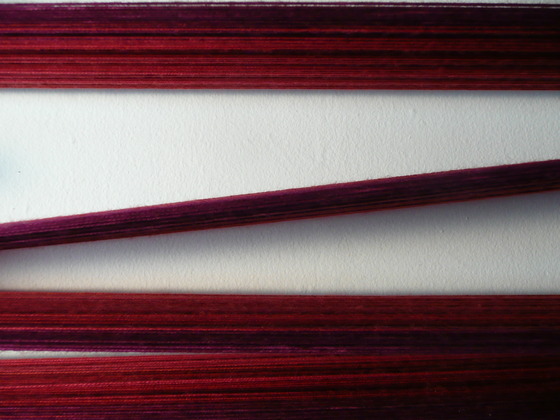
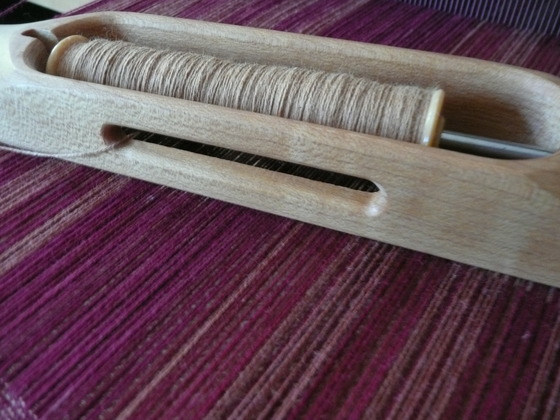
Over the months leading up to the show I have been dyeing tens of thousands of yards of organic cotton, silk, and wool with cochineal—a tiny insect from Oaxaca that produces a powerful red dye. I’m using this yarn to weave a number of blankets, pillows, and scarves for an installation that will take place in September. I am documenting this process of dyeing and weaving and will share this with you as I go. The gallery installation itself includes a space in which you can interact with the pillows and blankets handwoven from the dyed yarn as well as an area where I will be weaving a blanket out of the dyed yarn over the two-week period.
...
So what is the meaning of this piece and why cochineal?:
The installation's title: "The males have wings while it is the females whose bodies are crushed to extract their red dye. But red is also the color of the sun."
The cochineal insect has been used for its red dye for at least 1000 years in Mexico, Central and South America. It produces what is considered to be the best natural red dye in the world, used in everything from textile dyes and paint pigments to food coloring and cosmetics. The female insects contain carminic acid, which acts to protect her from certain predators while she is fertile. It is the carminic acid that also produces such a powerful red dye.
In the 1500s the dye became an important trade good under Colonialism, first exported from Mexico by the Spanish. It is one part of the history of colonial and capitalist exploitation of resources, people, and knowledge from the region.
This process of making contains a dual metaphor. It is a visualization of the violence that often lies behind the products we consume (even objects made for our own comfort and security). It is simultaneously a visualization of an alternative: a hand production process that brings together producer and consumer and that has thoughtfully considered the network of people and materials that make up the production of this particular object of comfort and intimacy (The materials I use in this case are organic or natural and come from small-scale producers and through personal relationships wherever possible).
The color red itself offers the potential of multiple meanings for the viewer. Throughout history it has symbolized power and strength; sin; anger; courage; warning; and love and intimacy. And for Aztecs, red is the color of the sun.
Go to the website to watch time-lapse videos on the dyeing and weaving processes.

And once you pledge to this cause, Tali will you send you handmade, hand-dyed yarn and other great pieces. Beautiful!

Saturday, August 28, 2010

lulled by the sounds of lullatone


My friend idrawsometimes recently posted about making your own ringtones, and I'm in the process of trying it out with songs by lullatone.

What do they sound like, you wonder?
They sound like light raindrops, crayons, children's sweaters, tiny robots, and bathtime bubbles. Have a listen, you'll see what I mean.

Wife and husband duo Yoshimi Tomida and Shawn James Seymour met when she was an exchange student in the states. When her visa expired, he decided to move back to Japan with her. At night, he would make music but since she was sleeping and he didn't want to disturb her, he made lullaby sounding songs, hence lullatone. Now they have a cute toddler named Niko, and live happily ever in a small but playful apartment in Nagoya. Cute!


Tuesday, August 24, 2010

[marketplace] your tush on a dandelion

I love modern design inspired by the natural world, and these fun, dandelion stools by london-based DesignK are a perfect example. They look so relaxing!

Friday, August 20, 2010

I'll show you my city if you show me yours

Toledo, panorama from south
Toledo, panorama from north
A stunning panorama sketch of Toledo, Spain. The labels let you pick out an old cathedrals and a mosque.
This is just one example of the many sketches from Urban Sketchers, a blog which encourages artists to sketch and share their cities.  

Friday, August 13, 2010

watercolor people


By Swedish artist and designer Stina Persson. And she has a show coming out in New York next month!
---
Edit: Whoa so pleased that I posted this before Oh Joy! It's nice knowing that the things I like are also the forefront of trendiness...maybe?

Wednesday, August 11, 2010

let's paint rio


Just saw this on the Oh Joy! blog, led by artists Haas &Hahn, a project called Favela Painting is transforming the favelas (the notoriously violent hillside slums) of Rio de Janeiro, Brazil into a giant, rainbow lollipop--bringing happiness as well as jobs, youth involvement, craftsmenship training, and income into the region.

(before picture)
(and, I love this part, after!)

Visit the site, or better yet, donate!

Friday, July 30, 2010

light is like water

Strange yet wonderful cover art by gali erez for Gabriel Garcia Marquez's short story, La Luz es como el Agua or Light is Like Water. (Excerpt below)

Pues habían abierto tantas luces al mismo tiempo que la casa se había rebosado, y todo el cuarto año elemental de la escuela de San Julián el Hospitalario se había ahogado en el piso quinto del número 47 del Paseo de la Castellana. En Madrid de España, una ciudad remota de veranos ardientes y vientos helados, sin mar ni río, y cuyos aborígenes de tierra firme nunca fueron maestros en la ciencia de navegar en la luz.
For they had turned on so many lights at the same time that the apartment had flooded, and two entire classes at the elementary school of Saint Julian the Hospitaler drowned on the fifth floor of 47 Paseo de la Castellana. In Madrid, Spain, a remote city of burning summers and icy winds, with no ocean or river, whose land-bound indigenous population had never mastered the science of navigating on light. 
Read the whole story here.

Thursday, July 29, 2010

Wednesday, July 28, 2010

the sketchbook project, I challenge you

To me, a sketchbook is a beginning. It's a place where not fully formed ideas can play for a little while. It's a testing ground. Now imagine a library that houses thousands of sketchbooks for you to check out and thumb through. Not only that, you can contribute your own. I just love this idea.

The Brooklyn Art Library is accepting participants for its annual Sketchbook Project until October 31, 2010. Participants receive a moleskin and a theme--they are due January 15 for the 2011 tour around the country, and you can also have them digitize it on their website. Anyone from anywhere in the world can apply.


I just signed up, and my theme is "And then there were none."
I'm getting an extinction/Lorax vibe.

If you have any ideas for me on that theme, please let me know. And if you decide to sign up (I challenge you!), feel free to drop a comment on what theme you chose.

One of my favorite submission so far comes from Alinac, with the bold theme: Dirigibles and Submersibles.

And a big thank you to Kat for the heads-up.

Sunday, July 25, 2010

depicting the contemporary American Indian

This past week Congress approved the long-overdue Tribal Law and Order Act (more on this exciting new development later). It has inspired me to do a brief series on the contemporary American Indian--a complex and loaded phrase/idea/identity, so I'd love to hear your thoughts.

First post in the series, featuring the art of Fritz Scholder:

A member of the Luiseno tribe, artist Fritz Scholder (1937-2005) often said that he was "not Indian," and would never paint the Indian. But when his students had trouble painting the American Indian in an un-clichéd manner, he began his "Indian" series, painting the American Indian wearing flags, in cars, with beer cans in a pop-art style, becoming a major influence and subject of debate for later generations of Native art. His art, prolific and controversial, makes us think and rethink who the contemporary American Indian is.

At the National Museum of the American Museum in DC, I was introduced to Scholder's work and life last summer. I would often visit the exhibit after a long day's work. I was captured by the colors, unique perspective, and the use of distortion in the faces and figures. I am still amazed that for someone so ambivalent towards his heritage, Scholder moved its art tradition to brave, new places.

Friday, July 16, 2010

ten thousand waves

Although I'm always pretty skeptical about any art piece/film that is Crouching Tiger/Hidden Dragon-esque (a great movie on its own terms, but has since become equated with Chinese, along the lines of Kung Fu and General Tso), I saw this 9-screen installation by Isaac Julien entitled Ten Thousand Waves recently at ShanghART (see my post on Mo Gan Shan road) and was fairly impressed. The stills below show off his photography skills- I like the colors and the depth and the fact that the beautiful Maggie Cheung joined the cast.


For me, the installation speaks about Chinese mythology in terms that are relevant today, like environmental sustainability. At one point, Maggie Cheung's goddess character overlooks the vastness of the seas, and it is implied that we, her children, are calling upon her.

Thursday, July 8, 2010

bambu jungle atop the city

(photo by Librado Romero for the NYTimes)

It's called Big Bambu: You Can't, You Don't, You Won't Stop by twin brothers, Doug and Mike Starn. Along with a group of artists and rock climbers, they have been continually adding to structure since April, hoping eventually to build it up to 50ft in the air. And did I mention that it is sitting on the roof of the Met Museum? The artists describe it as "organic" and "constantly changing like life," and I think that as humans, we're so well-known for our destruction, it's beautiful being reminded that we can also build up. And seeing the mess of bamboo, a game of pick-up sticks, atop such an austere, Neo-Classical building like the Met, I am reminded how nature, strong and unpredictable, has its own structures and patterns.

The exhibit closes in October. Let me know if you've gone to see it already, and what your thoughts are.

Saturday, June 19, 2010

contemplating mo gan shan road

My birthplace, Shanghai is currently all abuzz over the World Expo. Although I commend it for bringing together this sense of international friendship while highlighting this amazing city, it's a bit of a tourist trap. Unbearably long lines. Noisy people on their cell phones. A bit underwhelming, and sadly, because of the expo much of the city's old world flavor has now been lost to Western commercialization--such as the charming bargaining and bustle at Chen Huang Temple now replaced with... Dunkin' Donuts.

An alternative to the expo is Mo Gan Shan Road, a Shanghai's version of the Meatpacking District. What used to be rundown factories and warehouses are now artist havens. The tiny street surprisingly opens up to a complex full of nooks and crannies of studios and galleries. The forefront of China's contemporary art is located here, and the atmosphere is still strangely serene, tucked away from the high rises.

  (graffiti lined entrance, that's my mom looking hip)

Here's a favorite of mine, Korean artist Bon-A KOO, featured at Shun Art Gallery, Rm 103/208 Building 3
No.50 Mo Gan Shan Rd.

Sunday, May 23, 2010

[marketplace] Bolga Baskets

Currently *on sale* at Urbanoutfitters.com , beautiful hand-woven baskets from Bolgatanga, Northern Ghana! I definitely see these things around, being sold in boutiques around the Village and many other fair trade organizations. They're perfect for picnics, and the leather handles make them pretty sturdy.

These baskets have a special place in my heart. When I was in Ghana, I had the opportunity to hang out and interview some of the women in a co-op who were making them:


A group of American students, we began our trip in mid-November from the city of Tamale to the Upper Eastern Region of Ghana searching for Baobab trees. Passing a few hazy bushfires and seas of wispy fair-haired savannah grass, we finally came across a most majestic figure; the baobab, perhaps the most quintessentially African tree, stood with its portly trunk laden with fruit, hanging from its root-like limbs. Underneath, we were greeted with yet another surprise, colors. Bright hues of orange, green, and purple leapt into my eyes yet still somehow seemed to be a natural extension of the surrounding landscape.


The bodies which contained these colors were containers themselves of space, baskets. The scene soon became boisterous—interlaid with the baskets were fans, hats, gourds, dancing, and thunderous children with their humble mothers, their laps strewn with straw. Nevertheless, the beauty of the colors, intricacy of the patterns in their grassy-woven bodies, how they play with form and space convinced me that indeed these baskets are art and their creators, artists. 


These artists carry several identities; they are mothers and daughters, “Northerners,” strong African women, but in their society, they are deemed foremost as widows. Although these women have worked hard in perfecting their craft, they are still only known as the basket-weaving widows, which in this region is not only an overwhelming title but a crippling one. Thus, in order to study them as artists, we must not only have an understanding of the evolution of their craft but also their identities as widows, incorporating a dialogue about the pervasiveness of cultural traditions, especially those which continue to violate the rights and dignity of others. Only then could we appreciate their art for both their aesthetic qualities and the personal stories of struggle behind them. 


When the director of Widows and Orphans Ministry, Betty Ayagiba first came to speak to our student group in November, she was particularly distressed. Only moments earlier, a widow had entered her office with a broken arm. Her husband’s family had severely beaten her because she refused to choose a male relative to remarry. The practice of true levirate highlights one of the most controversial customs regarding widows in Ghana. Originating from Biblical times, it involves marrying the younger brother or nephew of the deceased husband to continue having children for that husband because marriage is meant to continue into eternity. Therefore, the widow has little power over her own body. WOM has found that levirate marriages are responsible for the spread of HIV/AIDS to the widows and to young men and also puts a financial strain on the widows for having to take care of so many children. Refusal to remarry often leads to physical abuse. On the one hand, these rituals are steeped in tradition forming an integral part of the cultural fabric for people in this region. However, like female genital mutilation (FGM) and facial scarring, since widowhood rites are discriminatory and oppressive to women, their place in Ghana today should be reconsidered. In Bolgatanga, there is this group of escaped widows who having been rejected by their own communities have come together to form their own community, supporting and finding a family in each other.


During my interview, one widow offered to teach me the basic double-weave technique. She had already completed the base of the round basket and was not weaving stripes of different colors around the different spokes in a circular fashion, building the body of the basket. The materials she uses are elephant grasses from Southern Ghana. They normally grow on riverbanks or swampy areas. After harvesting, they are sun-dried to guarantee a better quality basket. She then dyes them by submerging the grasses into vats of boiling artificial dyes. The weaving process begins by splitting each grass into two halves down the middle. These halves are then twisted together, making them more durable. These straws are then dipped into water, making the weaving process easier. The base begins with twisting together a set of straws to make a structure resembling a spider; individual legs stick out allowing straws to be woven horizontally in and out along the ribs. At the top of the basket, the ribs are pushed flat and a straw is looped around them, creating a rim. Handles, straw or leather, may also be added. Finally, the excess straws sticking out at the bottoms are trimmed. After mastering this process, weavers are free to develop their own patterns, structures, and styles leading to unique colorful and challenging creations. 


It is not difficult to understand why handicrafts like baskets or pottery are termed traditional art. Basketry is a traditional skill; it is traditional in the sense that it immortalized the Ghanaian, even African culture, but the art itself is certainly contemporary. We must give these women credit for being innovative and developing their own individual style, building upon but not simply copying the basketry of centuries past. This begs a further question: what is contemporary art? Does an artwork have to reinvent the wheel or be abstract to be called contemporary or could these baskets be tributes, “containers of memory,” celebrating a long-standing heritage but still being relevant in their own right today.


The women who created these baskets are contemporary, and this struggle between how we wish to divide art into traditional and contemporary reflects the same struggle of these women; it is the traditions surrounding widowhood which wholly encases and defines them, but are they not modern women? Weaving their stories & requires artistic vision and a contemplation of their present situation. If anything there baskets tell the stories to the international community of how they are overcoming a very contemporary issue in their society.

Link to a video of our trip by Jaimie Shaff.