Showing posts with label marketplace. Show all posts
Showing posts with label marketplace. Show all posts
Tuesday, August 24, 2010
[marketplace] your tush on a dandelion
I love modern design inspired by the natural world, and these fun, dandelion stools by london-based DesignK are a perfect example. They look so relaxing!


Wednesday, August 18, 2010
[marketplace] sale at IC
My dear dear friends at Invisible Children are having a "back to school" sale!
Stock up on hip IC swag and help former child soldiers & Northern Ugandan students get an awesome education.


Stock up on hip IC swag and help former child soldiers & Northern Ugandan students get an awesome education.
(messenger bag, bracelet of your choice, and tee at the store)
I wear my Sunday (black) bracelet all the time, and it reminds me of the people in Uganda who worked to make it, their children, and so many others in Africa and in the states inspiring and pushing for change.
Truly such a great organization with amazing people.
I'll leave you with some amazing shots of the Brooklyn Bridge when we participated in IC's worldwide event, The Rescue.
(photo by Eric Min)
Saturday, August 14, 2010
[marketplace] mr. and mrs. panda enjoy recreational sports
Something cute for a bon weekend!
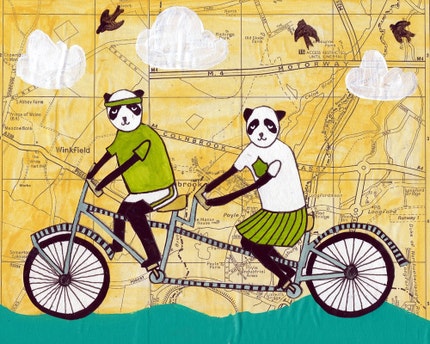
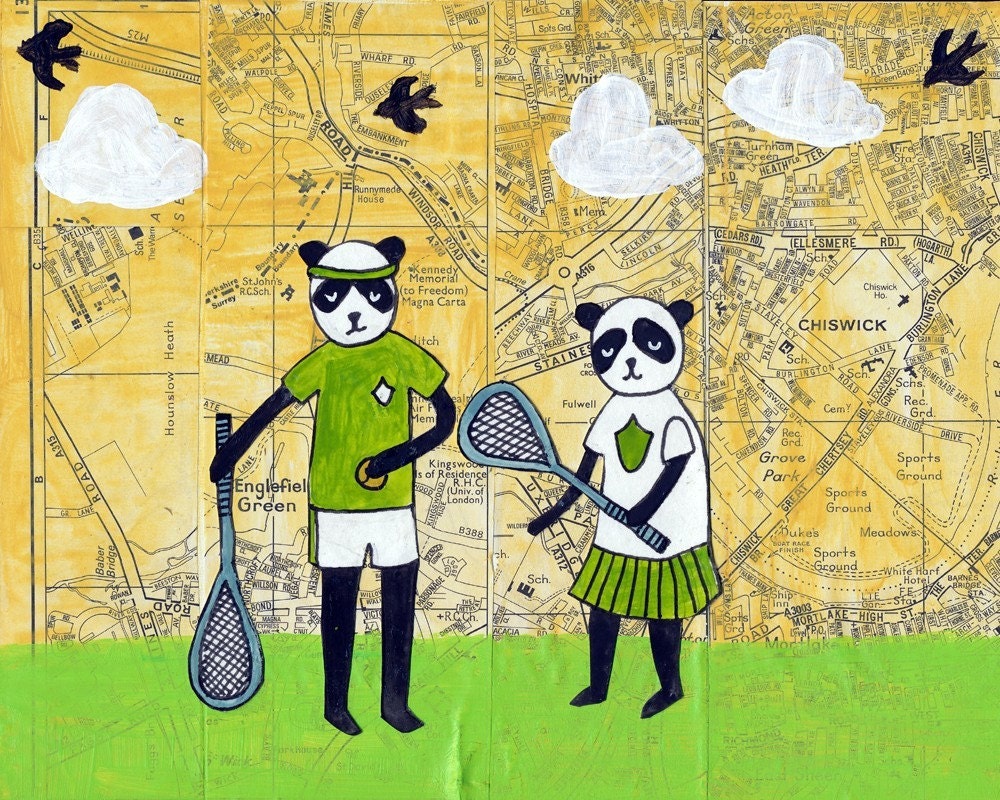
Whimsical! Find this sporty couple as well as other creatures at papersparrow.
Also, let me introduce you to a not so sweet panda, Herman, by my friend idrawsometimes. At least he's talking about fair trade.

Also, let me introduce you to a not so sweet panda, Herman, by my friend idrawsometimes. At least he's talking about fair trade.
Saturday, August 7, 2010
[marketplace] color palettes

Tuesday, August 3, 2010
[marketplace] animals and metal gears

A gladiator bird from Anthropologie, a steampunk trilobite with project instructions (more on steampunk at a later post), and a ram from Burrow Burrow.
So amazing! These are beginning to make me see everything with gears.
And if my dear friend Kat is still reading my blog, I think she (and hopefully you) will enjoy this.

(Wolf skull by Miss Monster)
Thursday, July 29, 2010
[marketplace] painted wood, sticks and slices

Painted sticks from Ginette Lapalme, and acrylic elm slices from reclaimed wood for sale at focuslineart.
[marketplace] sierra and bianca, together cocorosie
The last of my contemporary American Indian series, featuring musical duo Cocorosie:


(screenshots from Cocorosie's Lemonade)
From a Cherokee background, sisters Sierra and Bianca Casady as children were nomads. They moved around almost every year, living in Hawaii, California, New Mexico, and Arizona. Without formal education, they grew up learning art in the "real world." During summers, they would join their now estranged father on vision quests on various American Indian reservations--these experiences continue to inform their music. Now they are both based in France.
Their music has been characterized as "freak folk" experimental (think Devendra Banhart meets the childish voice of Joanna Newsom), mixed with hip hop, opera, electronic, the blues, and misc. sounds like owls cooing and children's toys. Basically, it's very unique and not for everyone.
For me, sometimes it's discordant and even difficult to listen to. But the moments of delicate melodies and Sierra's opera trained voice cut through the mess, and you suddenly learn that you're tearing up and you can't stop listening to it. My favorite: the album version of Werewolf, one of the few songs I have on continuous repeat.
They recently came out with their fourth album, Grey Oceans (2010). When asked about the inspiration for this album, Sierra spoke about the earth returning to its primeval, natural elemental beings--which are reflected in the androgynous/mystical/fantastical look of Lemonade and Smokey Taboo.
They will be playing in Brooklyn's Music Hall of Williamsburg September 15.
Tuesday, July 27, 2010
[marketplace] native heritage print blankets

Wrap yourself in these comfy, wool blankets from Pendleton meets Opening Ceremony, inspired by prints and patterns from the Yavapai and Sioux tribes.
Saturday, July 24, 2010
[marketplace] handlebar with care

Saturday, July 17, 2010

Thursday, July 15, 2010
[marketplace] hyped up on mate tea
In high-school, I used to work at a tea shop where I got to drink tea all day for free, so of course I made the most of it and went for the high-grade stuff, silver needle white tea at about $18 an ounce, or something outlandish like that. My skin never (again) looked better.
Anyway, since my last post (which, if anyone actually read the whole thing, props) was mainly about fair trade coffee, I wanted to share that in fact, I don't really drink coffee. Not only do I prefer the taste of tea, I get my caffeine fix from mate (pronounced maa-tay) tea, which I first learned about at that high-school job.
 What is yerba mate? It has the same amount of caffeine as coffee but without the jitter and crash, and even more antioxidants than green tea! You must be thinking, does this miracle beverage exist and where can I get some?
Yerba Mate is found native to the rainforests in South America, and the people there have been drinking it (traditionally from gourds) for centuries as a healthy pick-me-up.
A few years ago, representatives from Guayaki Yerba Mate came to visit NYU. This company sells bottled yerba mate in awesome, but not overpowering flavors--my favorite are the mint and the raspberry, although I hear they just came out with a peach that I can't wait to try. I love how Guayaki is not only organic, fair trade, and all around tasty, the company also supports reforestation in the area. I buy it from Space Market on University near NYU (it's a bit pricey at $3 a bottle, but that's comparable to a nice coffee beverage), and sadly I haven't seen it at Shoprite or Costco or anything, but if you're interested go the website. They also have this fun page about mate legends and myths.
Anyway, since my last post (which, if anyone actually read the whole thing, props) was mainly about fair trade coffee, I wanted to share that in fact, I don't really drink coffee. Not only do I prefer the taste of tea, I get my caffeine fix from mate (pronounced maa-tay) tea, which I first learned about at that high-school job.

Yerba Mate is found native to the rainforests in South America, and the people there have been drinking it (traditionally from gourds) for centuries as a healthy pick-me-up.
A few years ago, representatives from Guayaki Yerba Mate came to visit NYU. This company sells bottled yerba mate in awesome, but not overpowering flavors--my favorite are the mint and the raspberry, although I hear they just came out with a peach that I can't wait to try. I love how Guayaki is not only organic, fair trade, and all around tasty, the company also supports reforestation in the area. I buy it from Space Market on University near NYU (it's a bit pricey at $3 a bottle, but that's comparable to a nice coffee beverage), and sadly I haven't seen it at Shoprite or Costco or anything, but if you're interested go the website. They also have this fun page about mate legends and myths.
Tuesday, July 6, 2010
[marketplace] bike ride with the fireflies

Just returned from a nighttime bike ride in the park accompanied by a trotting Happy, the best dog ever, and fireflies. I love watching fireflies during summer nights, and I'm always so sad during some summers when they just aren't there. There's really nothing like staring into the woods, so dark that the leaves blend into the setting sky, and seeing millions of fireflies. It's like watching star constellations dancing or a cave full of glowing jewels, magical.
Here are some pretty things that make for a perfect bike ride with the fireflies. Wear this Sugar Jar blouse from Spool No. 72 and Bronze filigree ring at UO, and have your Stockholm Carrie bike basket from EmmoHome, Ecote Classic Canvas backpack, and Etched jars by Lyrial Zander. Then hang this Fireflies watercolor print by AlisaPaints in your bedroom to send you off to sleep.
Monday, July 5, 2010
[marketplace] looking for an excuse to eat more ice cream
Does social responsibility come to mind?

I always knew I loved Ben & Jerry's. They were the first US ice-cream maker to use fair trade ingredients and now they're committing to going all fair trade (that's a lot of flavors) in three years. In an article from foodnavigator-usa:
"By transitioning all of our coffee extract to fair trade, Ben & Jerry's hopes to help increase incomes for coffee producers," said Yola Carlough, head of social mission for Ben & Jerry's. "Displaying the fair trade logo on our pints will hopefully help raise awareness among consumers about how their buying decisions can support positive change."
Not only are they helping farmers earn what they deserve, Ben & Jerry's are spreading the message to other companies that indeed, fair trade is profitable.
"Consumers care about quality. Increasingly, they also care about where their food comes from and how the farmers who grew it were treated."
 See their map for more, and enjoy some Chunky Monkey guilt free this summer. Yum!

I always knew I loved Ben & Jerry's. They were the first US ice-cream maker to use fair trade ingredients and now they're committing to going all fair trade (that's a lot of flavors) in three years. In an article from foodnavigator-usa:
"By transitioning all of our coffee extract to fair trade, Ben & Jerry's hopes to help increase incomes for coffee producers," said Yola Carlough, head of social mission for Ben & Jerry's. "Displaying the fair trade logo on our pints will hopefully help raise awareness among consumers about how their buying decisions can support positive change."
Not only are they helping farmers earn what they deserve, Ben & Jerry's are spreading the message to other companies that indeed, fair trade is profitable.
"Consumers care about quality. Increasingly, they also care about where their food comes from and how the farmers who grew it were treated."

Thursday, July 1, 2010
[marketplace] why I love the shoes of tomorrow

Finally, a TOMS post! When I was an undergrad a couple years ago, a friend of mine introduced me to an up-and-coming organization with an interesting idea, buy a pair of shoes and they'll give another pair away to a child in South America or Africa. Since then, Blake Mycoskie's TOMS Shoes has absolutely exploded. In New York, I see them everywhere, even being sold in stores like Neiman Marcus. They have a commercial with AT&T, which is pretty cool. Plus, a few years ago I had to Google "toms shoes" now just "toms" is enough. That's how you know you've made it.
So here are five reasons why I love TOMS:
1. They are truly stylish and comfortable. I love how they are simple in style, perfectly fitting your feet without the bells and whistles, and that they are inspired by Argentinian cloth shoes. My pink and canvas classic TOMS (shown above) have lasted me through trips in West Africa and Asia, from the dusty trails near Cape Coast to the wet fish markets of Hong Kong to the mall (and trust me, I don't really take good care of them).

(that's me and my TOMS in Northern Ghana. photo by Jaimie Shaff, 2008)
2. Cordones. I just tried on my cousin's charcoal pair a few days ago, and they are unbelievably comfortable, like wrapping your feet in soft, downy cotton. Add a moleskin notebook and a well-trimmed mustache, and you're instantly a 1950s ex-pat poet living in a balmy, tropical place!
3. When their lives as shoes have run their course, you can take the leather soles and do a little diy crafting. Leather bracelet with a TOMS logo? Cute! I've even seen a TOMS soccer ball made entirely out of those soles. Awesome!
4. It's fun wearing and seeing others wear their convictions on their feet. True, the world is full of huge problems, and we often feel powerless to do something, to help people "over there." But as consumers in the US, we have incredible power everyday just by what we choose to purchase. The fact that TOMS is so trendy now shows that consumers care, and are willing to pay a little extra to do some good. More and more I'm able to be pleasantly surprised when I look down because I see people wearing TOMS--it's such a great feeling, being proud of complete strangers.
5. The final and best reason, the One for One Movement. Go to their YouTube channel and watch a shoe drop, your heart will just lift. I remember when CHILD(not)SOLDIER at NYU hosted a TOMS "design your own shoes" party, a volunteer told me that in many places like Sub-Saharan Africa and East Asia, there are soil-transmitted diseases that are just devastating for the people living there. It prevents adults from working and children from going to school, and all it takes to combat these parasites are shoes. Giving shoes to children who don't have them protects their feet, protects their bodies, allows them to go to school, and of course, lets them play!

(cordones and smiley kids)
Tuesday, June 29, 2010
[marketplace] fair trade Haitian mangoes
The last post got me thinking about mangoes from Haiti. As their main cash crop, with the most potential for market growth, mangoes present a way for farmers to rebuild their country's economy.
Most mango farmers in Haiti have a couple of trees, but as illustrated in the podcast from the previous post, there just isn't enough profit to help them expand their production. What they need is pretty simple like washing stations, irrigation, and plastic bins to keep the harvested mangoes from being bruised.
A huge fan of fair trade, I came across TransFair mangoes. TransFair USA has teamed up with Whole Foods to get those Haitian mangoes certified. By helping these farmers sell their goods "fair trade," those mangoes sell at a premium in exchange for organic, higher quality fruit (just like fair trade coffee), which helps to buffer the prices against volatile markets. Additionally, those farmers are able to organize themselves into democratic co-ops, essentially cutting out the middle-men. (No need to worry about those guys though, they usually get absorbed into the chain some other way, often even becoming farmers themselves).
In the end, the farmers benefit by having more funding to improve their business, the communities benefit through projects created from the premiums like new clinics or schools, and the consumers in the US benefit with higher quality goods and more importantly, knowing where our products come from.
Sometime in the near future, I'll definitely devote a whole post to what fair trade is (not free trade, that's something very different). In the meantime, a photo of just-harvested Haitian mangoes from TransFair USA:

Most mango farmers in Haiti have a couple of trees, but as illustrated in the podcast from the previous post, there just isn't enough profit to help them expand their production. What they need is pretty simple like washing stations, irrigation, and plastic bins to keep the harvested mangoes from being bruised.
A huge fan of fair trade, I came across TransFair mangoes. TransFair USA has teamed up with Whole Foods to get those Haitian mangoes certified. By helping these farmers sell their goods "fair trade," those mangoes sell at a premium in exchange for organic, higher quality fruit (just like fair trade coffee), which helps to buffer the prices against volatile markets. Additionally, those farmers are able to organize themselves into democratic co-ops, essentially cutting out the middle-men. (No need to worry about those guys though, they usually get absorbed into the chain some other way, often even becoming farmers themselves).
In the end, the farmers benefit by having more funding to improve their business, the communities benefit through projects created from the premiums like new clinics or schools, and the consumers in the US benefit with higher quality goods and more importantly, knowing where our products come from.
Sometime in the near future, I'll definitely devote a whole post to what fair trade is (not free trade, that's something very different). In the meantime, a photo of just-harvested Haitian mangoes from TransFair USA:

Thursday, June 24, 2010
[marketplace] tam tam and afropunk
This weekend. 2010 Afropunk Festival.
Commodore Barry Part, Fort Greene, Brooklyn.
There will be skateboarding, BMX, fashion and art booths, DJs, and live music.
get your tickets here.
I missed it last year, but hopefully I'll make it this time around. Sunday's music lineup includes Mos Def and K-OS!

This African wax print Tam Tam dress $315, from Boxing Kitten definitely gets me inspired for the festival.

Here's the beautiful Solange Knowles looking absolutely adorable in it.
And here's why I love Mos-Def, from GOOD Magazine: if Mos Def were president.
" If you have more, you should do more."
Commodore Barry Part, Fort Greene, Brooklyn.
There will be skateboarding, BMX, fashion and art booths, DJs, and live music.
get your tickets here.
I missed it last year, but hopefully I'll make it this time around. Sunday's music lineup includes Mos Def and K-OS!
This African wax print Tam Tam dress $315, from Boxing Kitten definitely gets me inspired for the festival.
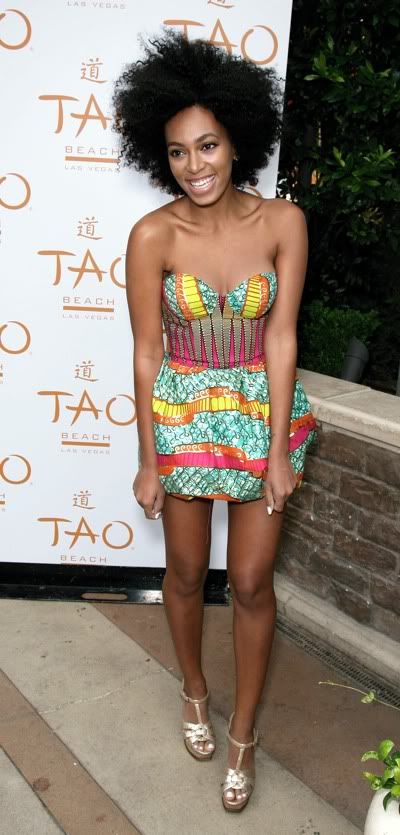
Here's the beautiful Solange Knowles looking absolutely adorable in it.
And here's why I love Mos-Def, from GOOD Magazine: if Mos Def were president.
" If you have more, you should do more."
Monday, June 21, 2010
[marketplace] burmese refugee crafts

 These pencil cases have a beautiful design, and I love the jewel tone colors. They are also fair trade and directly support anti-trafficking, which is such a huge issue in that region.
And to go along with your pencil case, these really sweet pencils exhibiting traditional Burmese dress.
I think these crafts remind us that even in the face of displacement, the lives of refugees go on. They find ways to make a living and try to improve their situation and that of their community.
You can find these products and learn more about these group of craftswomen at http://www.globalgoodspartners.org/cbo/KWAT/.
Sunday, May 23, 2010
[marketplace] Bolga Baskets

These baskets have a special place in my heart. When I was in Ghana, I had the opportunity to hang out and interview some of the women in a co-op who were making them:
A group of American students, we began our trip in mid-November from the city of
The bodies which contained these colors were containers themselves of space, baskets. The scene soon became boisterous—interlaid with the baskets were fans, hats, gourds, dancing, and thunderous children with their humble mothers, their laps strewn with straw. Nevertheless, the beauty of the colors, intricacy of the patterns in their grassy-woven bodies, how they play with form and space convinced me that indeed these baskets are art and their creators, artists.
These artists carry several identities; they are mothers and daughters, “Northerners,” strong African women, but in their society, they are deemed foremost as widows. Although these women have worked hard in perfecting their craft, they are still only known as the basket-weaving widows, which in this region is not only an overwhelming title but a crippling one. Thus, in order to study them as artists, we must not only have an understanding of the evolution of their craft but also their identities as widows, incorporating a dialogue about the pervasiveness of cultural traditions, especially those which continue to violate the rights and dignity of others. Only then could we appreciate their art for both their aesthetic qualities and the personal stories of struggle behind them.
When the director of Widows and Orphans Ministry, Betty Ayagiba first came to speak to our student group in November, she was particularly distressed. Only moments earlier, a widow had entered her office with a broken arm. Her husband’s family had severely beaten her because she refused to choose a male relative to remarry. The practice of true levirate highlights one of the most controversial customs regarding widows in

During my interview, one widow offered to teach me the basic double-weave technique. She had already completed the base of the round basket and was not weaving stripes of different colors around the different spokes in a circular fashion, building the body of the basket. The materials she uses are elephant grasses from Southern Ghana . They normally grow on riverbanks or swampy areas. After harvesting, they are sun-dried to guarantee a better quality basket. She then dyes them by submerging the grasses into vats of boiling artificial dyes. The weaving process begins by splitting each grass into two halves down the middle. These halves are then twisted together, making them more durable. These straws are then dipped into water, making the weaving process easier. The base begins with twisting together a set of straws to make a structure resembling a spider; individual legs stick out allowing straws to be woven horizontally in and out along the ribs. At the top of the basket, the ribs are pushed flat and a straw is looped around them, creating a rim. Handles, straw or leather, may also be added. Finally, the excess straws sticking out at the bottoms are trimmed. After mastering this process, weavers are free to develop their own patterns, structures, and styles leading to unique colorful and challenging creations.

It is not difficult to understand why handicrafts like baskets or pottery are termed traditional art. Basketry is a traditional skill; it is traditional in the sense that it immortalized the Ghanaian, even African culture, but the art itself is certainly contemporary. We must give these women credit for being innovative and developing their own individual style, building upon but not simply copying the basketry of centuries past. This begs a further question: what is contemporary art? Does an artwork have to reinvent the wheel or be abstract to be called contemporary or could these baskets be tributes, “containers of memory,” celebrating a long-standing heritage but still being relevant in their own right today.

The women who created these baskets are contemporary, and this struggle between how we wish to divide art into traditional and contemporary reflects the same struggle of these women; it is the traditions surrounding widowhood which wholly encases and defines them, but are they not modern women? Weaving their stories & requires artistic vision and a contemplation of their present situation. If anything there baskets tell the stories to the international community of how they are overcoming a very contemporary issue in their society.
Link to a video of our trip by Jaimie Shaff.
Friday, May 21, 2010
[marketplace] Of Rags
Buying fabric in Accra was, for me, always an exercise of optimism and possibility. On a top floor of the Kaneshie market, in tin-roofed stalls along major streets, even at a refugee camp, you can find some of the most colorful and imaginative, patterned fabrics--some in tie dye print and others hand stamped with West African Adrinkra symbols. You could get high off of a few yards of the stuff. Seriously.
I remember my housemates and I lived for the days when our lovely seamstress, Marjorie, would drop by to take down orders of our newest design-whims. One of my favorites was an apron pieced together with different swaths, and I was pleasantly surprised to see that Of Rags is offering a sweet dress in a similar style:


Of Rags is a fair trade fashion cooperative that benefits special needs children in Accra, Ghana while creating jobs for the community. On Tuesday, May 25, they're throwing a concept party, featuring their new line at Nuyorican Poets Cafe, 236 East 3rd Street (Between Ave B & C), $5 at the door. For more photos, check out their facebook page.
I remember my housemates and I lived for the days when our lovely seamstress, Marjorie, would drop by to take down orders of our newest design-whims. One of my favorites was an apron pieced together with different swaths, and I was pleasantly surprised to see that Of Rags is offering a sweet dress in a similar style:


Of Rags is a fair trade fashion cooperative that benefits special needs children in Accra, Ghana while creating jobs for the community. On Tuesday, May 25, they're throwing a concept party, featuring their new line at Nuyorican Poets Cafe, 236 East 3rd Street (Between Ave B & C), $5 at the door. For more photos, check out their facebook page.
Subscribe to:
Posts (Atom)


 Posts
Posts